
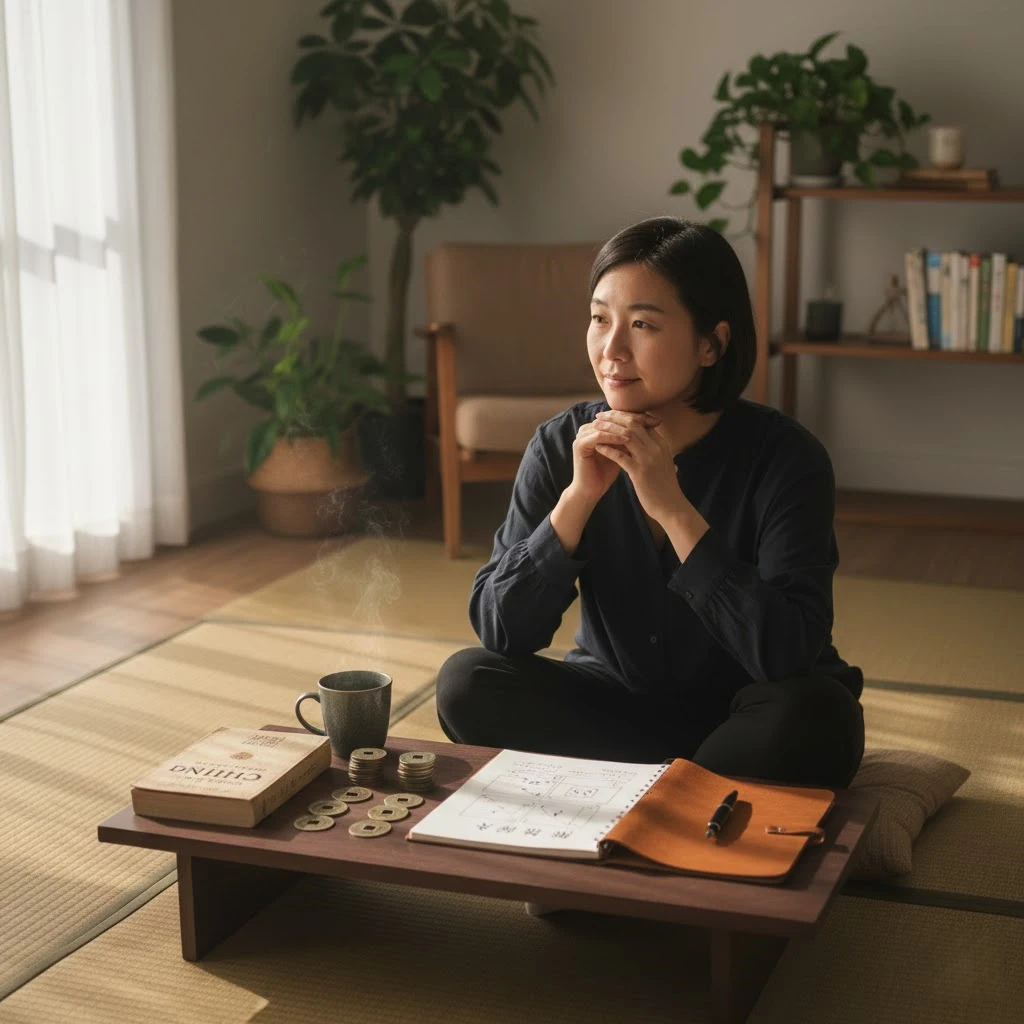
Personal growth is often described as progress — becoming better, stronger, more confident. In practice, it is more often about understanding limits, timing, and direction.
The I Ching approaches personal growth from a different angle. It does not ask who you want to become. It asks where you are now, and what kind of movement is appropriate.
That distinction matters.
Why Personal Growth Often Feels Stuck
- Repeating the same internal conflicts
- Feeling busy but directionless
- Oscillating between overconfidence and self-doubt
- Knowing something needs to change, but not knowing what or how
This is not a lack of motivation. It is usually a misreading of one’s current situation. The I Ching helps correct that misreading.
Self-Awareness Before Self-Improvement
Modern self-improvement focuses on action: habits, discipline, mindset shifts.
The I Ching begins earlier — with position awareness.
Each hexagram describes:
- The structure of the present moment
- The balance (or imbalance) between inner intention and outer reality
- Whether growth comes from restraint, preparation, or decisive movement
In many cases, the insight is not “do more,” but “stop pushing against what is not ready.” This alone can dissolve frustration.
Growth as Alignment, Not Acceleration
One of the I Ching’s most valuable lessons is that growth is not linear.
There are times for:
- Accumulating experience
- Observing rather than acting
- Letting internal clarity mature before external change
For personal development, this prevents:
- Burnout caused by constant self-optimization
- Shame from comparing progress to others
- Premature decisions driven by impatience
Growth becomes about alignment with reality, not constant acceleration.
Seeing Patterns Instead of Judging Yourself
Many people use self-reflection to judge themselves. The I Ching does the opposite. It externalizes the situation and lets you observe patterns instead of assigning blame.
A reading often reveals:
- Repeating dynamics you did not consciously notice
- Where resistance comes from (inside or outside)
- Which effort is wasted, and which effort is supported
This shift — from self-criticism to pattern recognition — is foundational for real growth.
Asking Better Questions for Personal Insight
The quality of insight depends on the quality of the question.
Helpful questions include:
- “What phase of growth am I currently in?”
- “What attitude supports development right now?”
- “What is holding me back — and is it meant to?”
Less helpful questions tend to seek validation:
- “Am I doing well?”
- “Am I on the right path?”
The I Ching works best when used for understanding, not reassurance.
Growth With Fewer Regrets
Personal growth does not mean avoiding mistakes. It means making decisions that are appropriate to your moment.
By clarifying timing, limits, and direction, the I Ching helps reduce:
- Reactive decisions
- Identity confusion
- Long-term regret from acting too early or too late
Over time, this creates a quieter kind of confidence — one based on awareness rather than constant change.
A Tool for Reflective Growth
The I Ching is especially suited for people who:
- Prefer reflection over motivational hype
- Want insight without ideology
- Value depth over speed
It does not promise transformation. It offers clarity, and clarity is often the most sustainable form of growth.
Personal growth also enhances your career and relationships. See Career Clarity and Relationship.